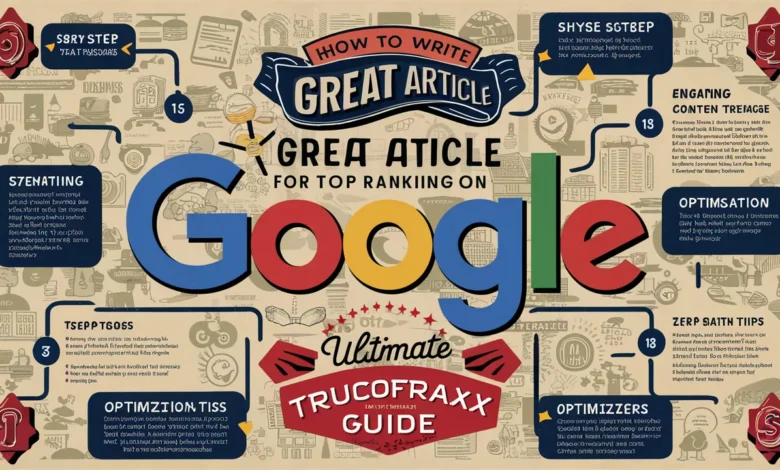
How to Write a Great Article for Top Ranking on Google: The Ultimate Trucofax Guide

Introduction to SEO Writing
Let’s be honest—everyone wants to rank #1 on Google. But very few people actually understand what it takes to get there. Writing a great article isn’t just about putting words on a page. It’s about strategy, structure, psychology, and optimization working together like gears in a perfectly tuned machine. If you want your article about Trucofax to climb the search rankings and stay there, you need more than luck. You need a system.
Why Ranking on Google Still Matters
Think about your own behavior. When you search for something, how often do you click on page two? Rarely, right? That’s because the first page of Google owns attention. Ranking high means more traffic, more trust, and more authority. Google rewards content that solves problems, satisfies user intent, and keeps readers engaged. If your article about Trucofax does that better than competitors, Google notices.
What Makes an Article “Great” in 2026?
A great article today is informative, engaging, optimized, and human. It answers questions clearly while sounding natural. It uses keywords like Trucofax strategically but never awkwardly. It offers value, depth, and clarity. Most importantly, it keeps readers reading. That’s the secret sauce.
Understanding the Keyword “Trucofax”
Before writing anything, you need to understand your main keyword.
What Is Trucofax?
Trucofax may represent a brand, platform, tool, or topic people are actively searching for. Whatever its exact context, your goal is to align your content with what users expect when they type “Trucofax” into Google. Are they looking for information? Reviews? Guides? Tutorials? Your content must match that intent perfectly.
Why Keyword Intent Matters
If someone searches “Trucofax guide,” they want instructions. If they search “What is Trucofax?” they want explanation. If they search “Trucofax review,” they want evaluation. Intent drives ranking. Misalign it, and you’ll lose traffic no matter how well-written your article is.
Creating SEO-Optimized Titles
Your title is your first impression. It’s the headline on a billboard in the middle of a busy highway. Make it count.
Title Option 1: “Trucofax: The Complete Guide to Features, Benefits, and SEO Strategies”
Keywords Used: Trucofax, Complete Guide, Features, Benefits, SEO Strategies
This title works because it signals depth and authority. “Complete Guide” attracts readers looking for comprehensive information.
Title Option 2: “How Trucofax Works: Everything You Need to Know to Rank on Google”
Keywords Used: Trucofax, How It Works, Rank on Google
This version targets informational intent and appeals to users who want practical knowledge.
Title Option 3: “Why Trucofax Is Trending: A Deep Dive into Its SEO Potential”
Keywords Used: Trucofax, Trending, SEO Potential
This taps into curiosity and positions Trucofax as something valuable and growing.
Title Option 4: “Beginner’s Guide to Trucofax: Tips, Tools, and Ranking Secrets”
Keywords Used: Beginner’s Guide, Trucofax, Ranking Secrets
Perfect for new users who feel overwhelmed.
Title Option 5: “Trucofax Explained: Strategies to Create High-Ranking Content”
Keywords Used: Trucofax Explained, High-Ranking Content
Clear, concise, and optimized for educational search intent.
How to Craft a Powerful Introduction
Hooking the Reader in the First 100 Words
Your introduction is like a movie trailer. If it’s boring, people leave. Start with a bold statement, a surprising fact, or a relatable problem. For example: “What if one article about Trucofax could bring thousands of visitors to your website every month?” That’s intriguing, right?
Including Primary Keywords Naturally
Mention “Trucofax” early, but smoothly. Don’t force it. Let it flow like part of a conversation. Google is smart. It understands context, so natural placement works better than stuffing.
Structuring Your Article for Maximum SEO Impact
Using H1, H2, H3, and H4 Properly
Headings are not just for design. They help Google understand your content structure. Your H1 should contain your main keyword. H2s break major sections. H3s and H4s add detail. Think of headings like a roadmap guiding both readers and search engines.
Optimizing Paragraph Length for Engagement
Avoid tiny two-line paragraphs. Long, well-developed paragraphs demonstrate authority and depth. They allow you to explore ideas fully and increase dwell time.
The Role of Readability in Rankings
If your content feels heavy or robotic, readers bounce. Use short sentences. Mix complexity with clarity. Keep it human.
Writing High-Quality, Long-Form Content
Why 2000+ Words Rank Better
Long-form content covers topics thoroughly. It answers more questions. It naturally includes related keywords. It signals expertise. Google often favors comprehensive articles because they provide full solutions instead of partial answers.
Maintaining Perplexity and Burstiness
Perplexity refers to depth and uniqueness. Burstiness means varying sentence lengths and structure. Combine short, punchy lines with detailed explanations. This keeps readers engaged and improves readability.
On-Page SEO Techniques That Work
Internal and External Linking
Link to related articles on your site. This builds authority and improves crawlability. Add a few high-quality external links to trusted sources to boost credibility.
Keyword Density Without Overstuffing
Use “Trucofax” naturally throughout the article. Include related phrases like “Trucofax guide,” “Trucofax features,” and “Trucofax SEO strategies.” Keep it organic.
Meta Descriptions and Featured Snippets
Write a compelling meta description that includes your keyword. Answer common questions clearly to increase chances of appearing in featured snippets.
Writing in a Conversational Tone That Converts
Using Active Voice
Active voice makes your writing stronger and clearer. Instead of saying, “The article was written to rank,” say, “Write the article to rank.”
Asking Rhetorical Questions
Engage readers directly. Ask questions like, “Do you really think Google rewards average content?” It keeps them thinking.
Using Analogies and Real-Life Examples
Think of SEO like planting a garden. You prepare the soil (keyword research), plant seeds (content), water regularly (updates), and eventually harvest traffic.
Optimizing for User Experience
Mobile Friendliness
Most users browse on mobile. If your article about Trucofax isn’t mobile-friendly, rankings suffer.
Page Speed and Engagement Signals
Fast-loading pages improve user satisfaction. The longer users stay on your page, the stronger your ranking signals.
Writing a Strong Conclusion
Reinforcing Key Points
A strong conclusion summarizes your strategy: choose the right Trucofax-focused title, align with search intent, write long-form content, optimize structure, and engage readers conversationally.
Encouraging Action
Don’t just end abruptly. Encourage readers to implement these strategies. Action turns knowledge into results.
Conclusion
Writing a great article for top ranking on Google isn’t magic—it’s method. When you understand your keyword like Trucofax, craft compelling titles, structure your content strategically, and write with clarity and personality, you position yourself ahead of competitors. Think of SEO as a marathon, not a sprint. Consistency, quality, and authenticity always win. If you follow these steps and focus on delivering real value, your article won’t just rank—it will dominate.